
How the Definition of Institutional Risk Has Changed
Brian Weinblatt, Ph.D., CFRE
Founder and Principal, Higher Ed Consolidation Solutions
This summer, a familiar story in American higher education has taken on a very unfamiliar cast. In June, Syracuse University Chancellor J. Michael Haynie told faculty and staff that the university would not meet its Fall 2026 undergraduate enrollment target, resulting in a budget deficit the university had not experienced in quite some time. He described enrollment volatility as widespread, unpredictable, and the “new normal” even for strong, well-resourced universities.
Temple University presents a different but equally instructive case. The institution entered fiscal 2027 budget planning with a projected $85 million deficit, largely rooted in seven years of enrollment decline. It subsequently approved approximately $60 million in reductions and eliminated 236 positions, with about 40 current employees directly affected.
Then, less than two weeks later, Temple reported 6,682 first-year undergraduate deposits, the highest number in its history and a 4.7% increase from the same point last year. Both developments are real. A record entering class is an encouraging sign, but it does not immediately reverse years of enrollment erosion or repair a structural operating imbalance. Institutional health cannot be read from a single metric.
Moody’s, meanwhile, revised Brown University’s outlook from stable to negative while affirming its Aa1 rating. Brown reported approximately $8 billion in endowment and other managed assets at the end of fiscal 2025. The outlook revision is not a credit downgrade, and it certainly is not evidence that Brown is in existential danger. That is precisely why it matters: even at an institution with extraordinary resources, operating pressures became substantial enough to change an external rating agency’s assessment of the direction of its credit profile.
Viewed individually, each of these developments can be explained by circumstances particular to the institution. Viewed together, they suggest something much more significant.
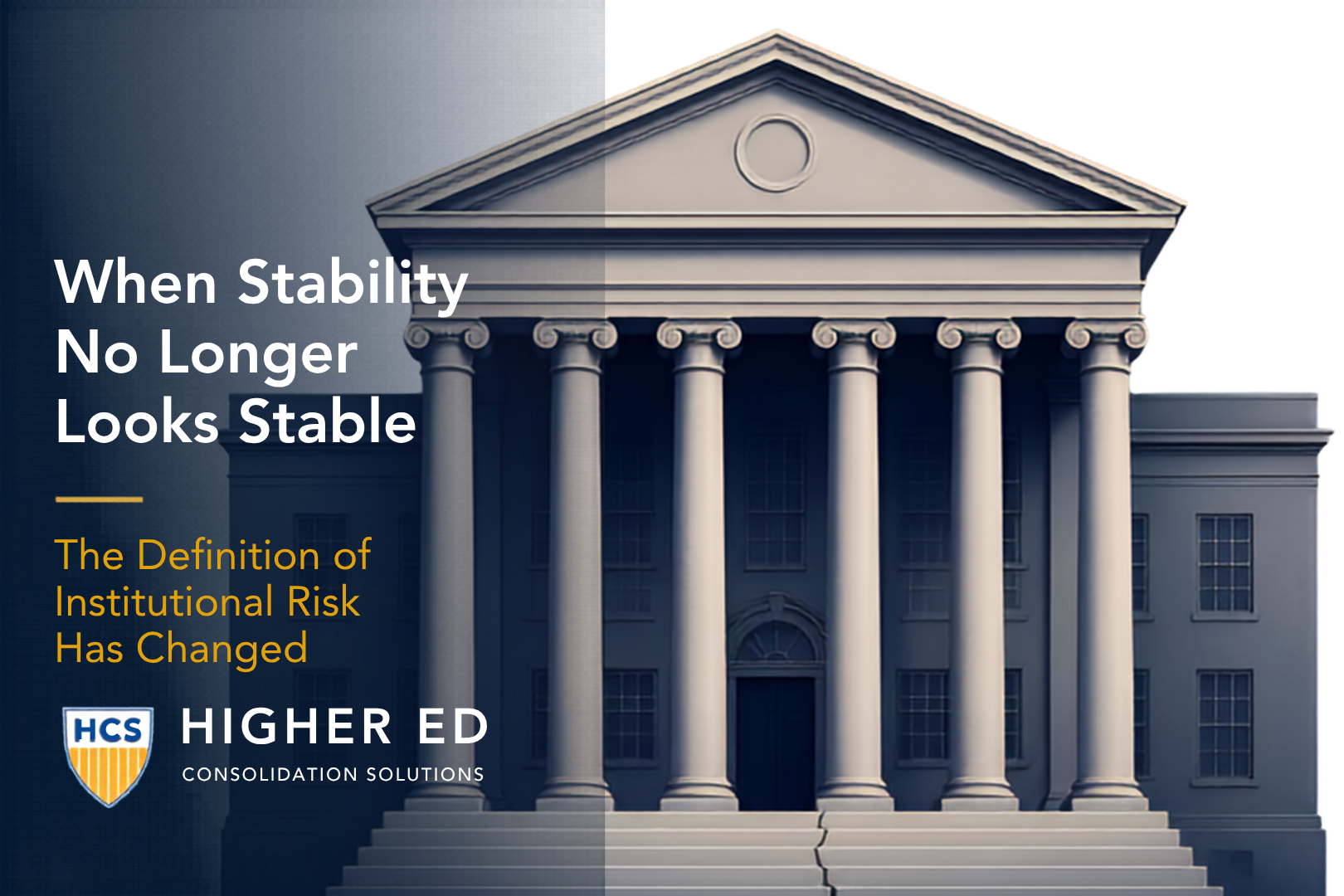
The Definition of Institutional Risk Has Changed
For years, boards and presidents built their mental maps of institutional risk around a fairly predictable group of colleges and universities: small, tuition-dependent private colleges; regional public universities in demographically challenged markets; and institutions already carrying persistent deficits or experiencing sustained enrollment decline. Those were the places where closures, mergers, financial exigency, and major restructuring seemed most likely to occur.
Large, selective, nationally recognized, or well-endowed institutions occupied a different category. They certainly faced challenges, but many assumed they inhabited a fundamentally safer zone. That assumption is becoming increasingly difficult to defend.
The pressure is not appearing everywhere in the same form, and that is part of what makes the pattern so consequential. At Syracuse, the immediate signal is undergraduate enrollment. At Temple, it is the accumulated effect of multiyear enrollment erosion on a cost structure that did not decline at the same rate, even as the newest entering class appears exceptionally strong. At Brown, operating performance, expense pressure, and debt obligations are substantial enough to produce a negative credit outlook.
At Johns Hopkins, the outstanding value of the university’s multiyear federal research portfolio declined by more than $500 million during 2025. The university reported receiving 43% less federal research funding and 28% fewer awards than in the prior year, with the downward trajectory continuing into 2026. The contraction has since contributed to the elimination of approximately 110 positions.
Different institutions are affected through different revenue channels, which is precisely why the pattern matters. This is no longer only a story about struggling colleges trying to survive. It is also a story about institutions once regarded as exceptions publicly acknowledging that the operating environment has changed.
That does not mean every prominent institution is headed toward crisis. It means the old binary distinction between “safe” and “at risk” is becoming less useful. A more revealing question is how much strategic flexibility an institution retains if its assumptions about enrollment, revenue, research support, or operating costs prove less reliable than they once appeared.
Systemic Stress, Not a Single Crisis
None of the underlying pressures is new. Demographic decline has been forecast for years, competition for traditional-age students has intensified, and international enrollment has become more volatile amid visa delays, changing policies, geopolitical conditions, and growing uncertainty among prospective students and their families.
That uncertainty increased again in July, when the Department of Homeland Security finalized a rule replacing the “duration of status” framework for F students and J exchange visitors with fixed periods of admission, generally limited to the length of the approved program or four years, whichever is shorter. The rule takes effect September 15 and will create new extension-of-stay requirements for some international students and scholars, along with additional administrative obligations for the institutions and program sponsors that serve them.
Federal research funding has also become less predictable. At the same time, labor, financial aid, technology, regulatory, and facilities costs continue to rise. Tuition discount rates remain significant across much of the sector, while public confidence in the value of higher education continues to evolve.
Any one of these pressures might be manageable for many institutions. Their convergence changes the risk profile. Most important for governing boards, this environment is no longer confined to institutions already known to be fragile. It is increasingly the operating environment across American higher education.
Financial Strength and Institutional Resilience Are Not the Same Thing
One of higher education’s most persistent assumptions deserves reconsideration. For years, leaders at smaller institutions have understandably expressed some version of the same thought: If only we had a $250 million endowment. If only we had $500 million. If only we had their brand, alumni base, or fundraising capacity.
Those advantages matter, but they are not the same as institutional resilience. An institution can possess substantial assets, strong liquidity, an outstanding reputation, exceptional faculty, and excellent facilities while still operating within a structurally unsustainable business model.
Endowments are not checking accounts. They are collections of individual funds, many of which are legally restricted by donor intent and governed by spending policies designed to support the institution across generations. A larger endowment expands strategic options, but it cannot simply be redirected indefinitely to offset recurring operating deficits.
Well-resourced institutions also tend to carry substantial fixed costs, including faculty, research infrastructure, student services, technology, facilities, debt service, and increasingly competitive financial aid strategies. Their operating models still depend upon enrollment, tuition revenue, sponsored research, philanthropy, and other revenue streams that can become less predictable.
Brown is not a cautionary tale of impending institutional failure. It is a particularly visible reminder that balance-sheet strength and operating-model sustainability are different questions. Financial strength buys time and options, but it does not, by itself, guarantee institutional resilience. A larger endowment does not eliminate difficult decisions; it allows leaders to make them from a position of greater strength, provided they begin early enough.
The Governance Variable That Matters Most
Over the past several years, I have had the privilege of sitting with governing boards, presidents, and leadership teams across a wide range of institutions. One pattern has become increasingly clear: the most productive conversations rarely begin with, “How do we solve today’s immediate problem?” They begin by asking, “What assumptions about our institution deserve to be challenged before circumstances force us to challenge them?”
Recognition precedes action.
Recently, one institutional leadership team asked a question that has stayed with me: “Which strategic levers should we begin evaluating—and when?” They were not asking because they had exhausted their options. They were asking because they wanted to preserve them.
That increasingly represents the most meaningful dividing line in higher education. It is not elite versus non-elite, wealthy versus resource-constrained, or public versus private. The distinction is one of strategic timing. Institutions that recognize change early retain more flexibility. Institutions that wait until financial pressures become undeniable often discover that many of their most constructive options have quietly disappeared. By then, the conversation has narrowed from strategy to necessity.
Questions Worth Asking Now
By early August, most presidents, enrollment leaders, and chief financial officers have considerably more visibility into the fall than they did when these headlines first appeared. Orientation is underway or complete. Housing assignments and course registrations are taking shape. Enrollment teams are monitoring summer melt, and many institutions are already modeling contingency scenarios even though final census numbers are not yet available.
The numbers are becoming clearer, but the strategic questions should not wait for them. Three questions, in particular, are worth placing before every board and leadership team:
1. What does our trajectory look like over five years—not simply this fall?
How are enrollment, discounting, net tuition revenue per student, retention, and program-level demand trending across multiple cycles? Which assumptions in our current plan are supported by evidence, and which are largely expressions of hope?
2. Where are we structurally exposed?
How dependent are we on a limited number of revenue streams, whether international students, sponsored research, graduate enrollment, auxiliary enterprises, or a small group of high-margin academic programs? What happens to the operating model if one of those revenue sources contracts by 10%? What happens at 20%?
3. Which strategic levers are we genuinely prepared to evaluate while meaningful choices remain?
These may include academic portfolio review, pricing and financial aid strategy, new approaches to teaching and learning, employer and community partnerships, shared services, operational redesign, capital sequencing, affiliations, acquisitions, or mergers where appropriate. None of these is the right answer for every institution, but all are easier to evaluate and pursue from a position of strength than under duress.
These questions are not about predicting institutional failure. They are about recognizing that the definition of institutional risk has changed, and that governance practices must evolve with it.
The institutions that navigate this period most successfully will not necessarily be those with the strongest brands or the largest endowments. They will be those willing to challenge long-held assumptions while meaningful strategic flexibility still remains.
In today’s higher education environment, resilience is not the absence of pressure. It is the capacity and the willingness to recognize change early enough to act before circumstances dictate the response.
Brian Weinblatt is Founder and Principal of Higher Ed Consolidation Solutions (HCS), where he advises college and university boards and senior leaders on institutional strategy, sustainability, partnerships, and transformational change.