
For-Profit Postsecondary Education Sector - Q1 2026 Overview
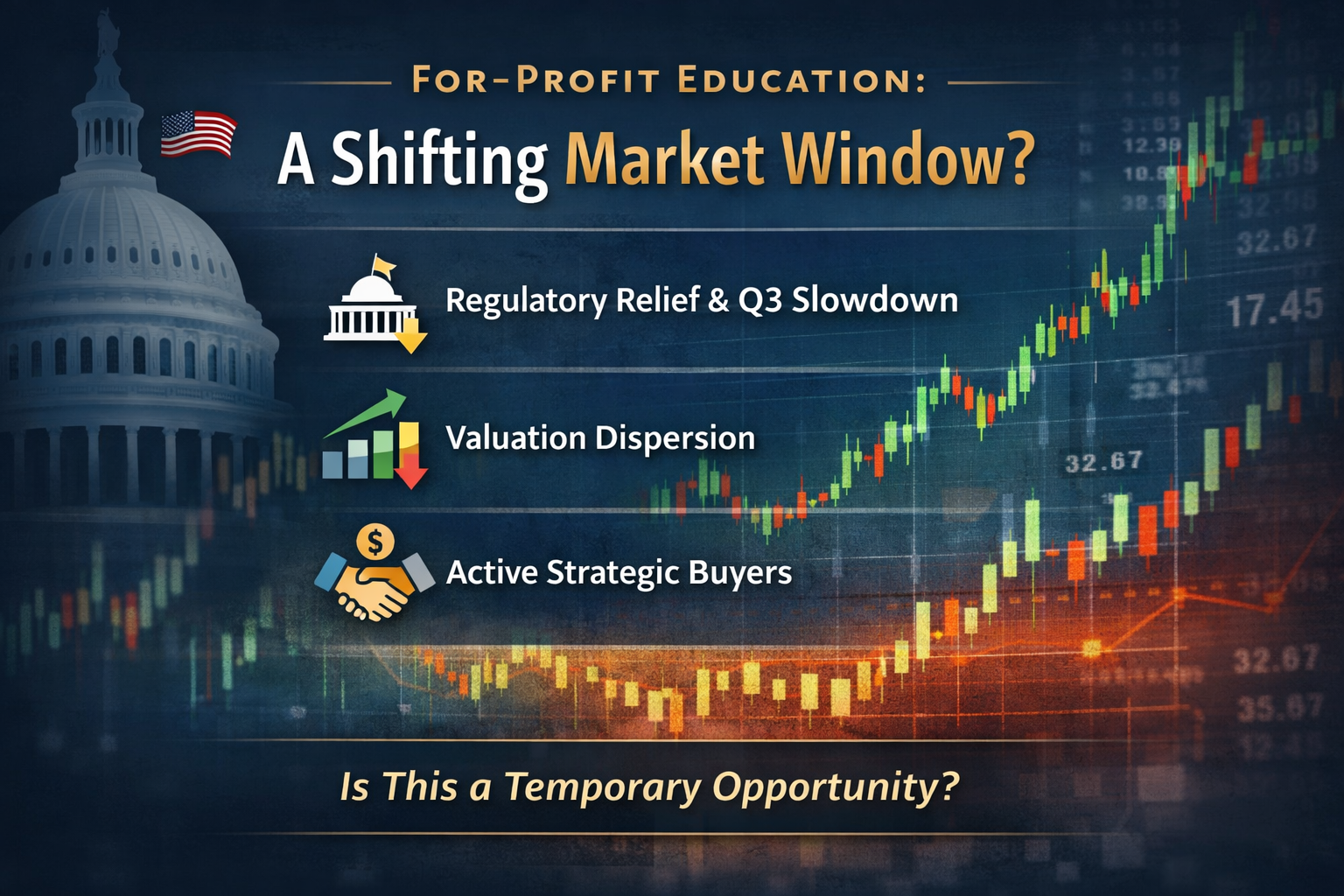
The For-Profit Higher Education Sector Has A Unique and Temporary Window of Opportunity To Transact
Historically, public policy and attitudes toward for-profit education have been driven largely by government administrations and the overall state of the economy. Generally speaking, republican leaders have tended to prioritize market continuity while democratic leaders have prioritized oversight and rulemaking.
Today, the regulatory framework is defined and implemented. There is no active legislative overhaul underway. Buyers can model forward exposure under known rules. The next political cycle could materially shift tone, rulemaking, and enforcement intensity. when that happens, valuation multiples may compress— even if operations remain unchanged. This is a period where regulatory risk is priceable. That will not persist indefinitely.
AI Investment Requirements Are Raising the Bar for Standalone Institutions
AI is reshaping curriculum delivery, student support, marketing optimization, compliance monitoring, and content production. Meaningful investment in data infrastructure, adaptive learning systems, and AI-enabled student services will be required to remain competitive. Scaled platforms can fund and integrate these capabilities. Consolidation may become a strategic necessity rather than an option.
Strategic Buyers Have Available Credit to Make Transactions Happen
Operators are generating strong free cash flow and carry modest leverage. Debt markets are open, and equity values have stabilized. Strategic buyers transact when capital is available and confidence is high — these conditions exist today.
Valuation Multiples Analysis
Source: Seeking Alpha
Key Insights
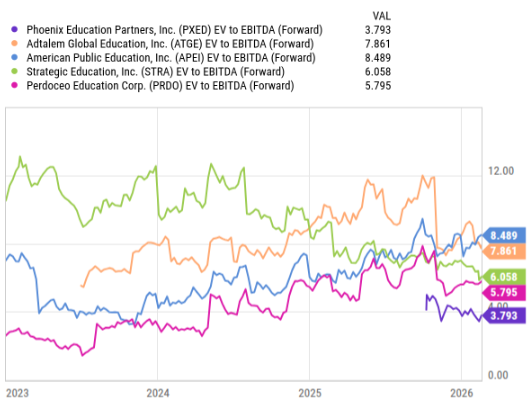
The Sector Re-Rated Post Q3 2025. As fundamentals Disappointed, multiples compressed.
There Is A Wide Dispersion of Valuation Multiples. The market is differentiating on: enrollment growth, margin expansion, programmatic quality, and perceived durability of earnings given AI advancements.
APEI Currently Commands the Highest Multiple. This premium is based on the integration of acquired asset Rasmussen, visible enrollment recovery, and margin expansion.
Stock Price Performance Post-Election
Source: Seeking Alpha
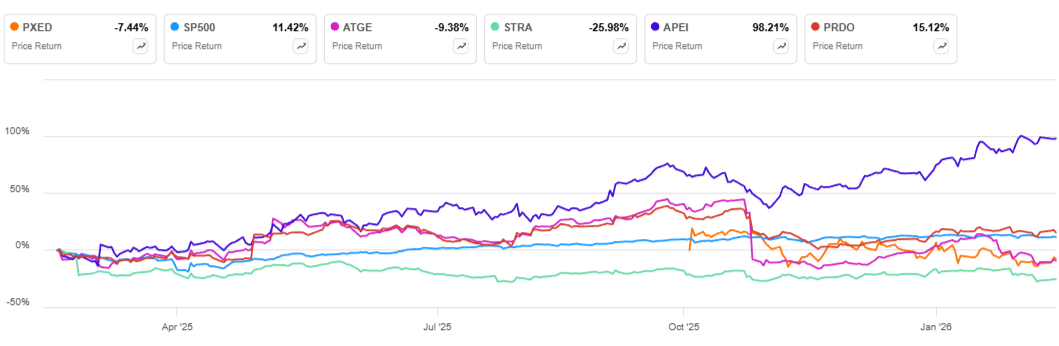
Following the 2024 election, for-profit education stocks experienced a sharp relief rally. Investors anticipated a more favorable regulatory environment. Several names appreciated 30-50% in the months immediately following the election as the market priced in reduced policy risk.
However, as the year progressed, particularly into Q3, the market moved away from regulatory relief as the primary driver and refocused on company-specific fundamentals. Q3 proved to be a weak quarter across much of the sector, with enrollment softness and margin pressure weighing on results. As fundamentals took precedence over policy expectations, the most publicly traded for-profit education stocks retraced a meaningful portion of their post-election gains.
If you’d like to explore M&A opportunities for your for-profit institution, contact Ariel Sokol or Zach Wasilew for a confidential consultation.